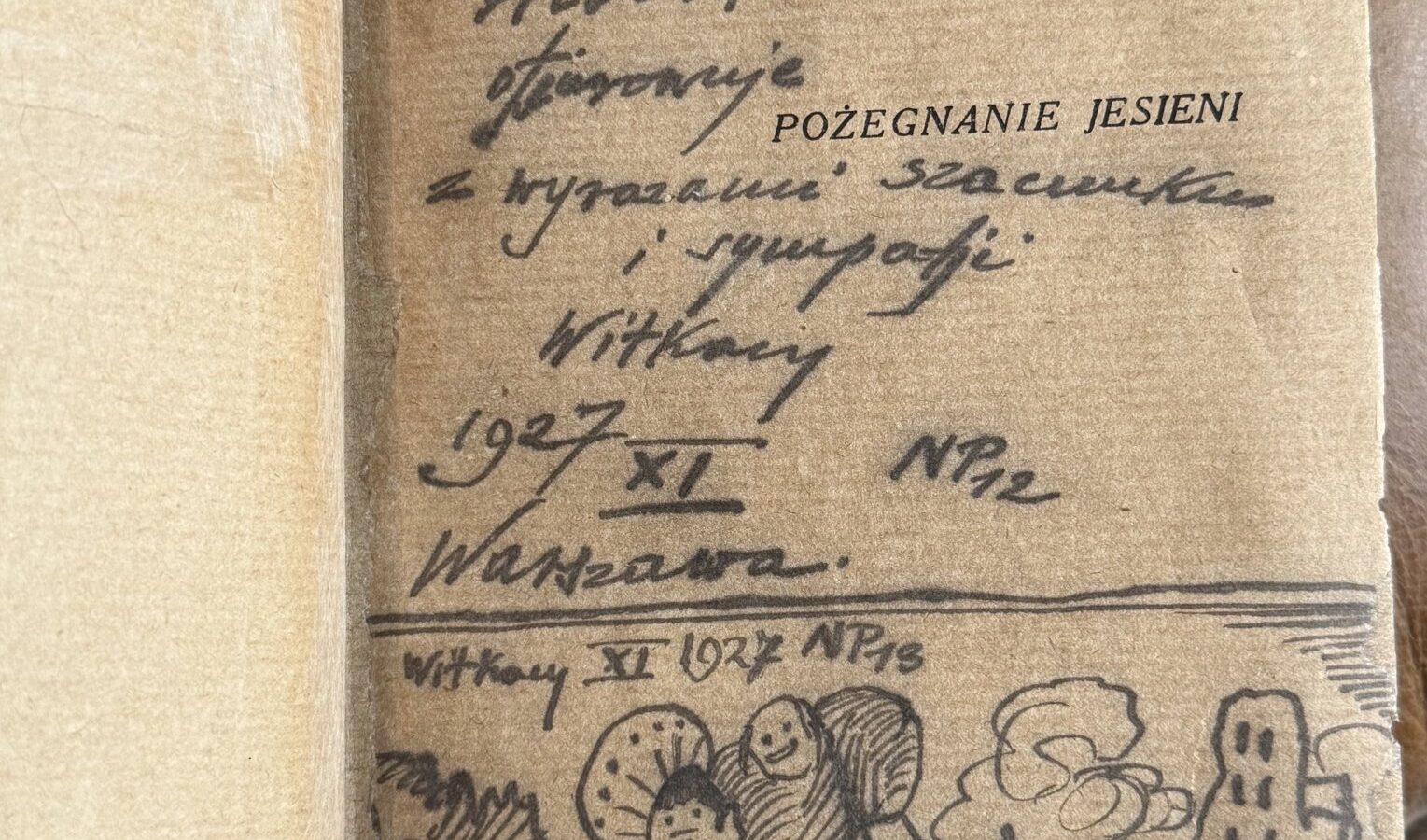
Some books are bought for the text, and some for what someone added to it. The copy that has long been part of our collection belongs to both groups. Dealers call such books association copies: what matters is not only who wrote them, but to whom, when and in what circumstances the author gave them. It is a first edition of Stanisław Ignacy Witkiewicz’s “Pożegnanie jesieni” (“Farewell to Autumn”), published in Warsaw in 1927 by F. Hoesick, and it bears traces of the author’s hand: an inscription, two ink drawings, a pencil sketch in the margin of the text and, a few years later, a correction to the novel’s own printed dedication.
The first novel published in the author’s lifetime
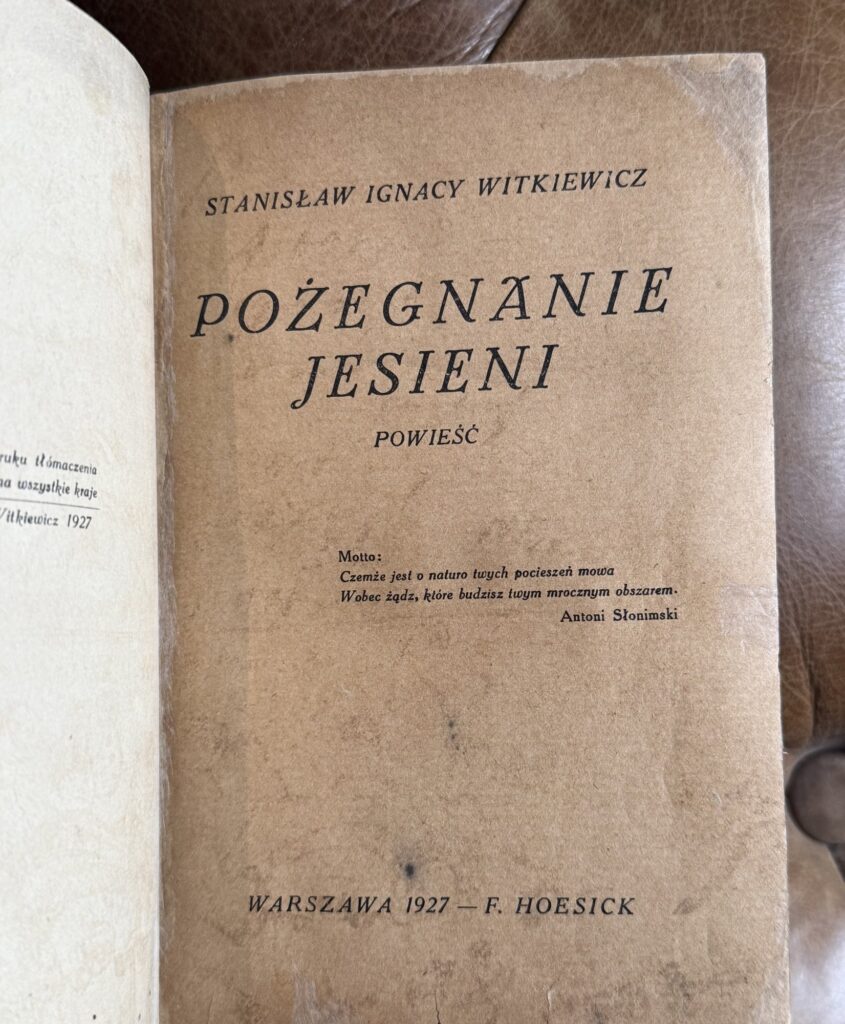
“Farewell to Autumn” was the first of Witkacy’s novels to appear during his lifetime; the earlier “The 622 Downfalls of Bungo”, written in 1910–1911, was published only after his death. The title page carries a motto from Antoni Słonimski and the imprint Warszawa 1927, F. Hoesick. Critics were unkind: Emil Breiter titled his July 1927 review in “Wiadomości Literackie” simply “Pseudo-novel”. Witkacy did have defenders, among them Stanisław Alberti, husband of the recipient of our inscription, who in 1928 published the essay “A Solitary Artist. On the margin of ‘Farewell to Autumn’” in “Świat Kobiecy”. A proof copy with the author’s corrections also survives, and modern editions of the novel draw on it.
“To Mrs Kazimiera Alberti”
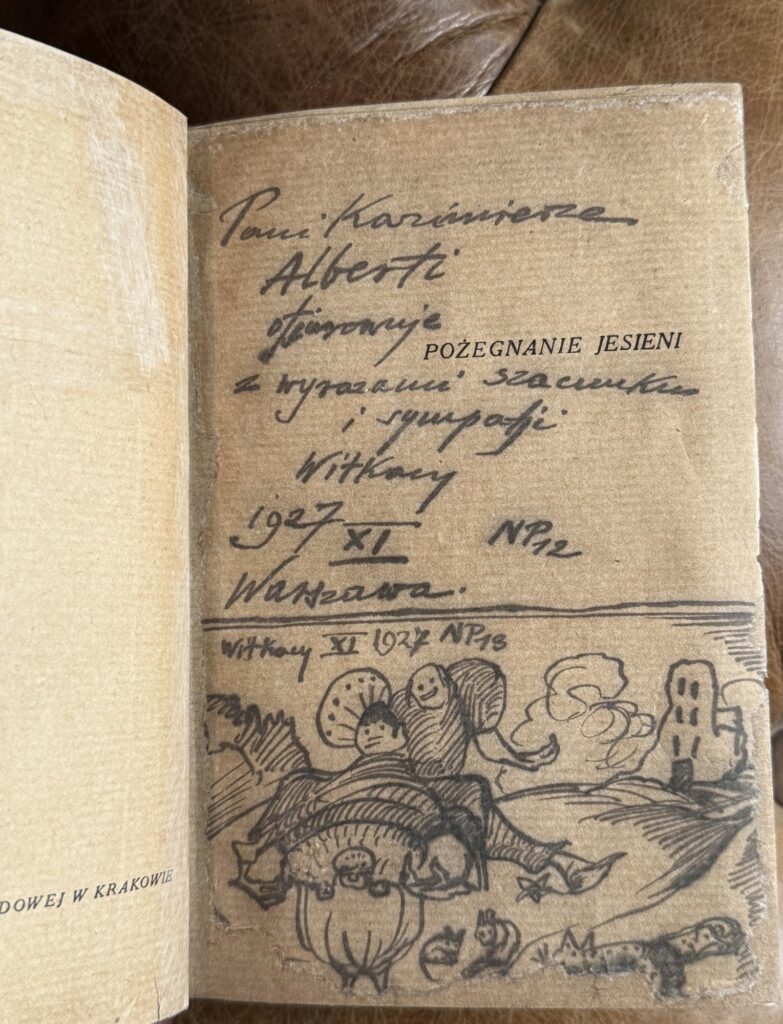
On the half-title, around the printed title, Witkacy wrote in ink: “Pani Kazimierze Alberti ofiarowuje z wyrazami szacunku i sympatii Witkacy 1927 XI NP12 Warszawa” (presented to Mrs Kazimiera Alberti with expressions of respect and sympathy). Below a ruled line he drew a scene of figures, plants and a building, signed separately “Witkacy XI 1927 NP13”. Kazimiera Alberti (1898–1962) was a poet, novelist and journalist, a graduate of Jan Kazimierz University in Lwów. Witkacy knew her and her husband Stanisław from at least 1926, when his letters to his wife mention visits to the Albertis in Kraków; after the summer of that year the couple moved to Warsaw, which matches the place in the inscription. Witkacy portrayed Kazimiera several times, and her 1927 collection “Mój film” includes a section titled “Three Portraits”.
What “NP12” means
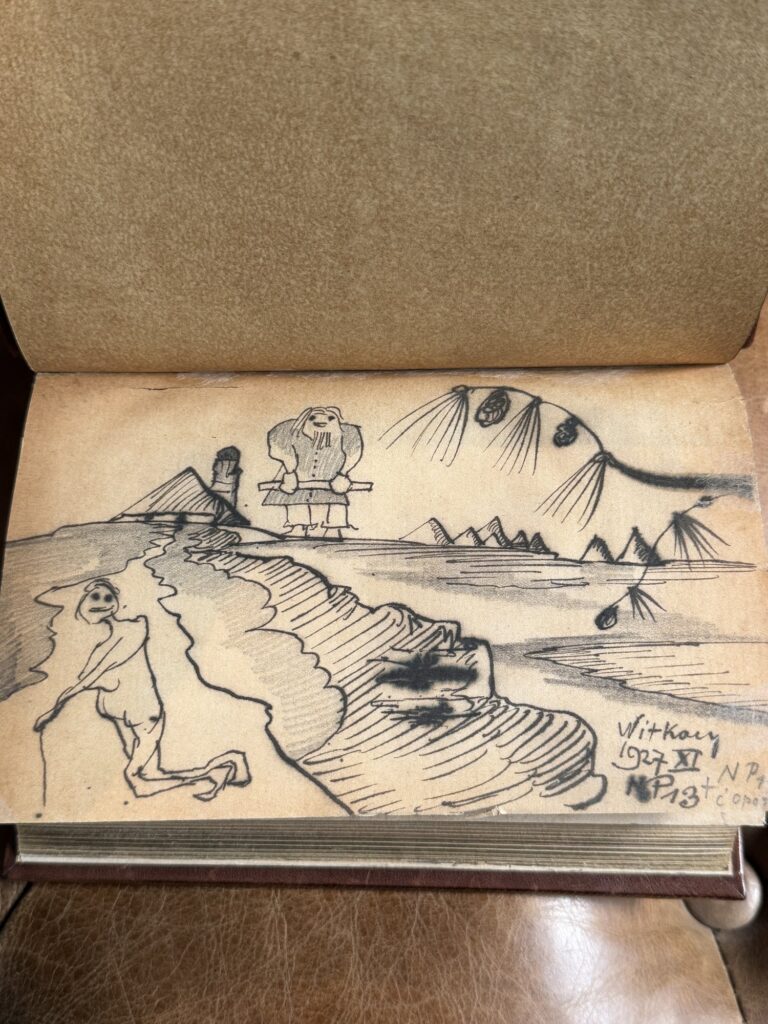
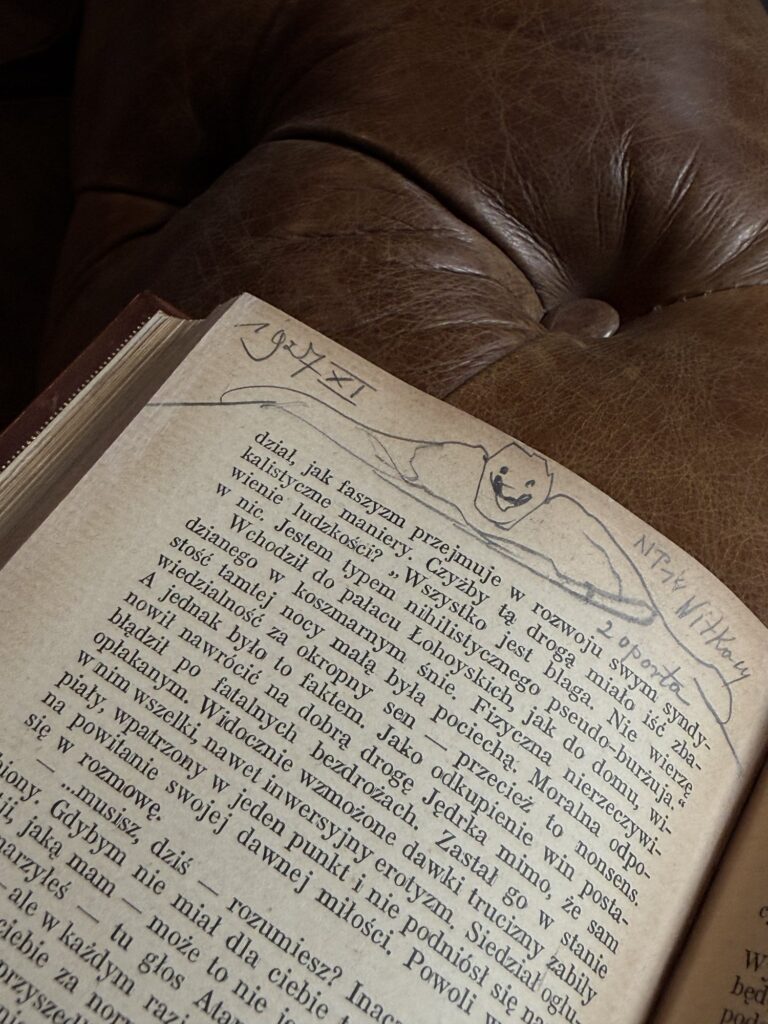
Anyone who has seen the pastels of Witkacy’s Portrait Firm knows these abbreviations. “NP” meant he had not smoked, and “NΠ”, with a Greek pi, that he had not drunk. According to auction catalogue descriptions, the number after “NP” gave the days since his last cigarette. In our copy the inscription carries “NP12”, and the drawing below it and a full-page drawing on another leaf carry “NP13”. The pencil sketch in a page margin bears the number 14, but the abbreviation before it is hard to read. All the notes are dated November 1927. It looks as if Witkacy returned to the book on at least two consecutive days before handing it over; this is our reading of the notes, not a documented fact. A few small pencil notes beside two drawings cannot be read with certainty, so we do not interpret them.
Witkacy corrects Witkacy
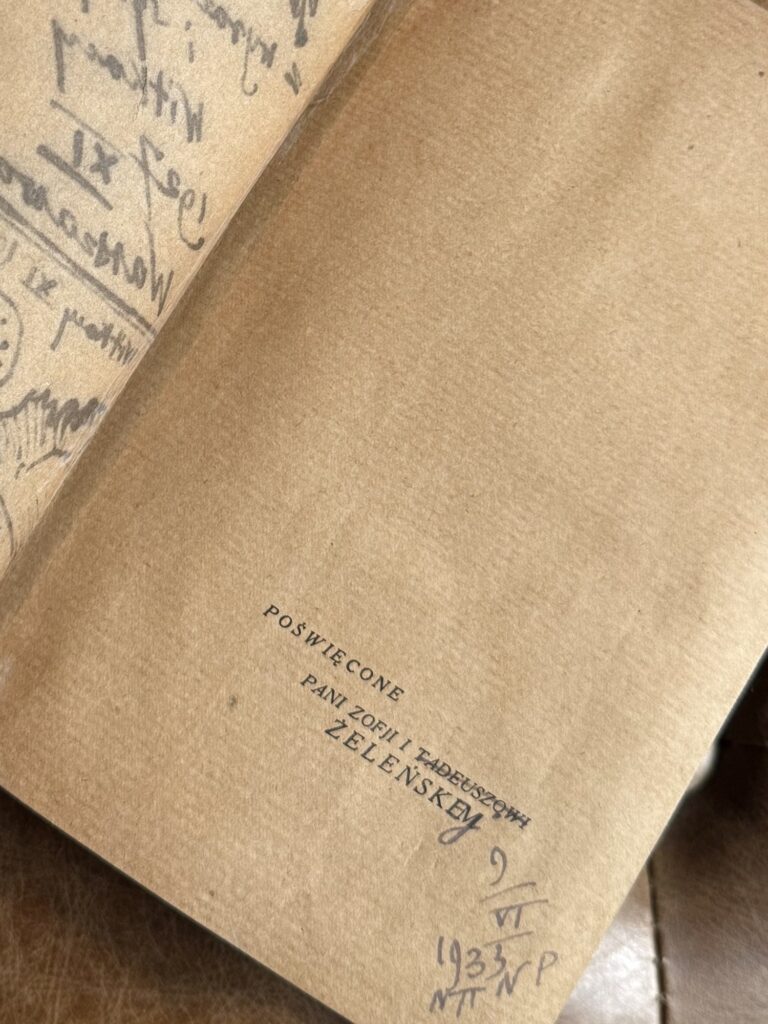
The novel’s printed dedication reads “To Mrs Zofia and Tadeusz Żeleński”. In this copy “Tadeusz” is struck through and the surname altered so that the dedication now reads to Mrs Zofia Żeleńska alone. Beside it are the date “9/VI 1933” and the marks “NΠ NP”. From 2 to 12 June 1933 Witkacy was staying with the Albertis, who from 1930 lived in Biała Krakowska and kept a literary salon there. Everything therefore points to the correction having been made in the recipient’s home, in her copy. Tadeusz Boy-Żeleński had for years been one of Witkacy’s closest friends and one of the first to recognise his work; their relations cooled in the early 1930s. Whether the strike-through was a gesture of resentment, a joke for his hostess, or both, no document tells us.
The copy
Stanisław Ignacy Witkiewicz, Pożegnanie jesieni. Powieść. Warsaw 1927, F. Hoesick. First edition. Leather binding executed in our bindery, gilt edges, original publisher’s wrappers retained. Autograph presentation inscription in ink on the half-title to Kazimiera Alberti, dated “1927 XI”, with an ink drawing signed “Witkacy XI 1927 NP13”; full-page drawing in ink and pencil signed “Witkacy 1927 XI NP13”; pencil sketch in the margin of a text page, dated “1927 XI”; in the printed dedication the name of Tadeusz Boy-Żeleński struck through in the author’s hand, with the note “9/VI 1933”. Provenance: Kazimiera Alberti (inscription); later history unknown; now in the Antykwariat Polski collection.
In our conservation studio the book underwent comprehensive conservation and restoration, aimed at stabilising the paper and preserving all of the author’s inscriptions and drawings in their original state. Our bindery then gave it a new leather binding with gilt page edges, retaining the original publisher’s wrappers. The book is now stable and safe to handle, while the patina of the paper, a natural trace of its nearly hundred-year history, has been left untouched.
Other inscribed books in our shop include Julian Stryjkowski’s “Austeria” (1966), Ryszard Kapuściński’s “Imperium” (1993) and Zygmunt Nowakowski’s “Z księgi zażaleń pielgrzymstwa polskiego” (Brussels, 1949). This copy of “Farewell to Autumn” is not for sale: for us it is a true rarity, and it remains in the Antykwariat Polski collection. If you are looking for similar books, would like conservation or a new binding for your own copy, or simply want to talk about Witkacy, contact us; to hear about new arrivals first, join our newsletter.

