On Thursday 26 November at 7 pm (CET) the 22nd Antykwariat Polski Auction begins. Bidding takes place live online on the OneBid platform, and the auction catalogue holds 24 lots with starting prices from 600 to 19,000 zł. The oldest left a Kraków printing house in 1696, the youngest a Warsaw one in 1928. Between them are books from Jesuit Poznań, from Warsaw under the Duchy and the Kingdom of Poland, Polish classics from Krasicki to Sienkiewicz, and ten volumes of „Chimera”, a celebrated journal of the Young Poland movement. Please join us for a short walk through the catalogue.
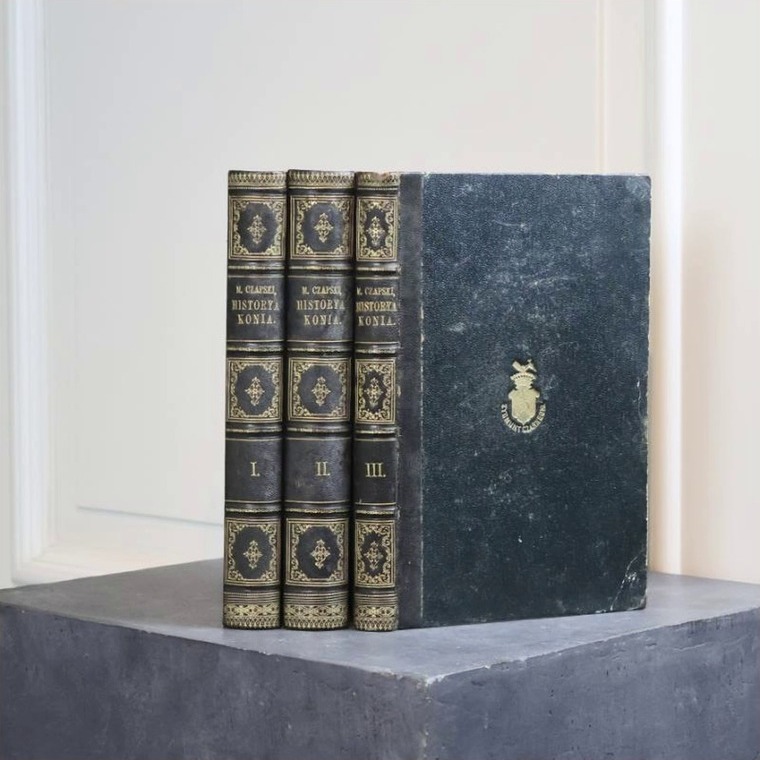
In our view this is one of the most interesting catalogues we have prepared this year. To our mind, the rarities of this sale are all thirty issues of „Chimera”, printed in a run of just 600 copies, the three volumes of Czapski’s „History of the Horse” with Count Czarnecki’s armorial stamp, and Wacław Potocki’s armorial, which turns 330 this year. Copies like these tend to stay in private libraries for decades, so the next chance to acquire them may be a long time coming.
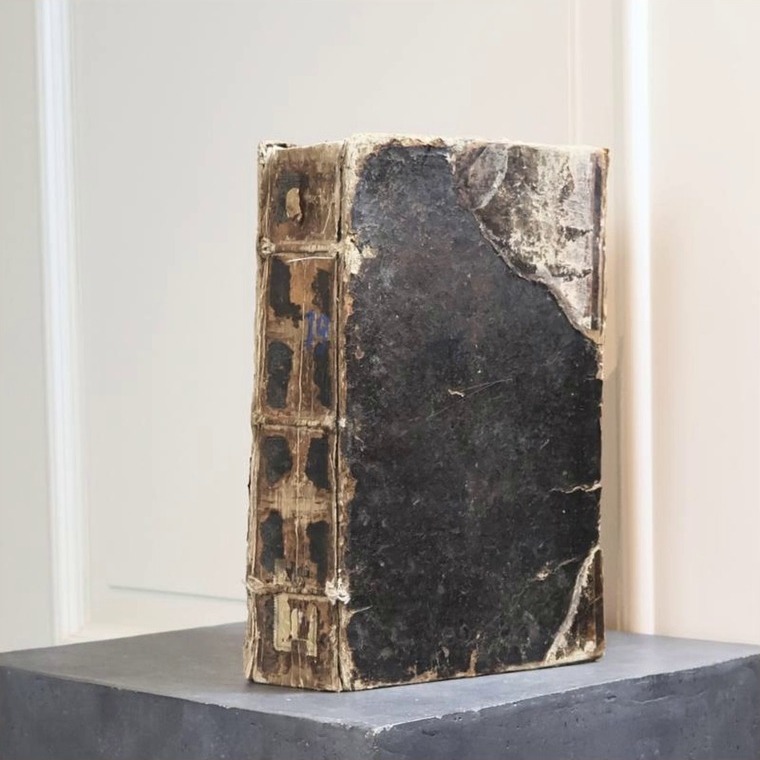
An Armorial in Verse from 1696
The oldest book in the sale is Wacław Potocki’s „Poczet herbów szlachty Korony Polskiej i Wielkiego Księstwa Litewskiego” (A Roll of the Arms of the Nobility of the Polish Crown and the Grand Duchy of Lithuania), printed in Kraków in 1696 by Mikołaj Aleksander Schedel, typographer to His Royal Majesty. It was the year of the poet’s death. Potocki, author of „The Transaction of the Khotyn War” and „The Garden of Epigrams”, saw only two minor works in print besides this armorial; most of his vast output reached readers in the 19th and 20th centuries. The „Poczet herbów” describes in verse the coats of arms of the nobility of Poland and Lithuania, recalling the history of individual families. The text carries woodcut coats of arms, and the verso of the title leaf shows the arms of the Kingdom with the Sobieski Janina on the eagle’s breast. The edition opens with the printer’s dedication to the princes Jakub, Aleksander and Konstanty Sobieski. The copy keeps its contemporary leather binding; the missing leaves are listed in the catalogue description. Beside it in the catalogue is the first volume of the 1741 Warsaw reissue of Mikołaj Zalaszowski’s „Jus Regni Poloniae”, a compendium of the law of the old Commonwealth that served as a textbook at the Kraków Academy.
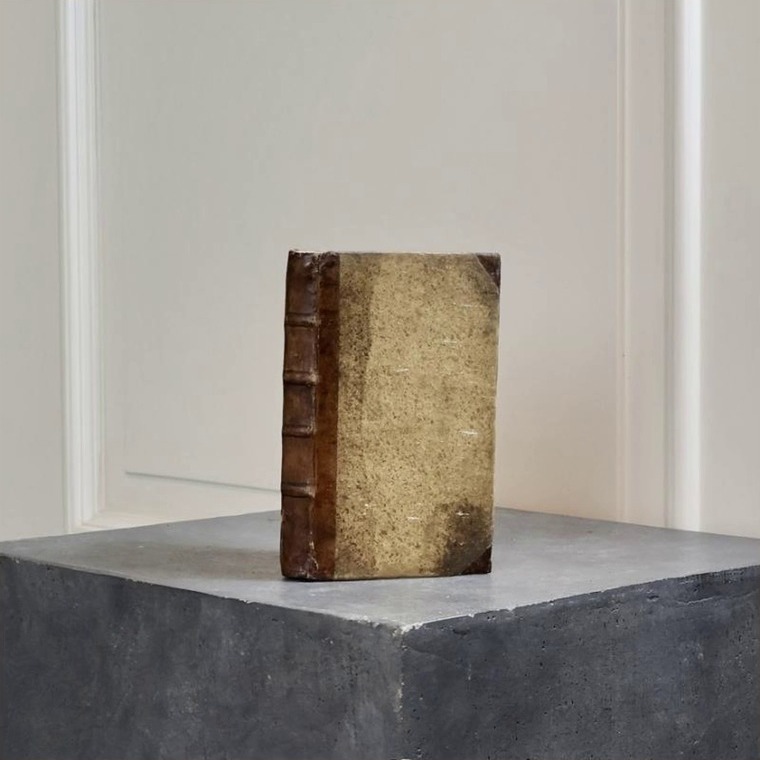
Japan from the Jesuit Press in Poznań
Among the eighteenth-century lots is „Historia prześladowania wiary chrześcijańskiej w Japonii” (A History of the Persecution of the Christian Faith in Japan), printed in 1763 at the Jesuit College press in Poznań. It is a Polish translation of part of the history of the Society of Jesus written in Rome by the French Jesuit Joseph de Jouvancy, translated by Franciszek Rzepnicki, archivist of the Greater Poland province of the order. The book covers the years 1591–1616, when Christianity in Japan went from rapid growth to bloody repression. In February 1597 twenty-six Christians were executed in Nagasaki, canonised in 1862. The Poznań Jesuit press issued at least 730 titles, and this one appeared ten years before the suppression of the order. The copy is in a contemporary half-leather binding.
Warsaw in Three Scenes
There is a good deal of Warsaw in this catalogue. The largest Warsaw lot is Kazimierz Władysław Wójcicki’s three-volume „Cmentarz Powązkowski pod Warszawą” (Powązki Cemetery near Warsaw), printed by Samuel Orgelbrand in 1855–1858. Wójcicki, a folklorist, chronicler of Warsaw’s literary life and an acquaintance of Fryderyk Chopin, combined descriptions of tombs and inscriptions with biographies of those buried there, and the volumes are illustrated with lithographs by Maksymilian Fajans after drawings by Alfons Matuszkiewicz. Our copy carries a woodcut bookplate of Józef Zawadzki by Maria Hiszpańska-Neumann, a graphic artist who survived Ravensbrück and illustrated more than ninety books after the war. Earlier Warsaw is represented by the first volume of the „Dziennik Dekretów Sądu Kassacyjnego Xięstwa Warszawskiego” of 1810–1811, printed at the Government Press: the official reports of a court of cassation that sat for barely two years.
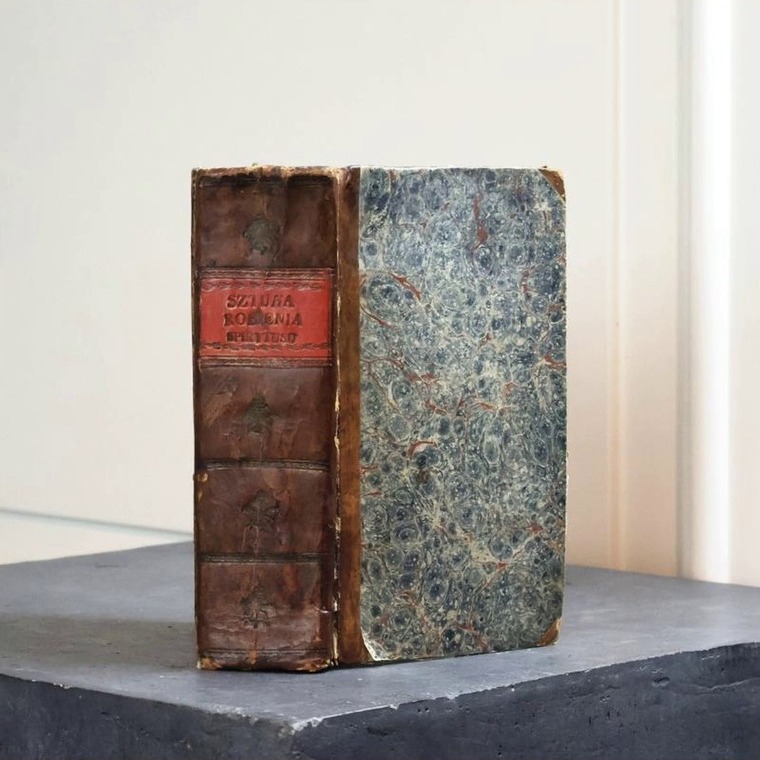
From the Kingdom of Poland comes a book that always raises a smile: Adam Dunin’s „Wykład teoretyczno-praktyczny sztuki wyrabiania i pędzenia spirytusu, robienia wódek i likierów” (A Theoretical and Practical Treatise on the Art of Making and Distilling Spirits, Vodkas and Liqueurs), published in 1820 by Natan Glücksberg, bookseller and typographer to the Royal University of Warsaw. It is a manual of distilling of almost seven hundred pages with eight plates, five of them copper engravings of distilling apparatus. The edition is recorded by Estreicher.
From Krasicki to „Chimera”
Polish literature is represented mainly by collected editions. Natan Glücksberg published Ignacy Krasicki’s „Dzieła” (Works) in ten volumes in Warsaw in 1829, the same year the poet’s remains were moved from Berlin to Gniezno Cathedral. There are also the „Pisma” (Writings) of Narcyza Żmichowska of 1885–1886, with a long biography of the author by Piotr Chmielowski, and the jubilee edition of Zygmunt Krasiński’s „Pisma” of 1912, prepared for the centenary of the poet’s birth.
The catalogue also includes the first book edition of Henryk Sienkiewicz’s „Quo Vadis”. The novel was first serialised in the press, and in 1896 Gebethner and Wolff issued it in three volumes, printed in Kraków by W. L. Anczyc. This edition bears no edition statement, while the next, of 1897, already reads „Wyd. 2.” on the title page. In 1896 the novel also appeared in English in Boston and London and in Russian in St Petersburg and Moscow, and nine years later Sienkiewicz received the Nobel Prize. The National Library of Poland keeps copies of the first edition among its treasures.
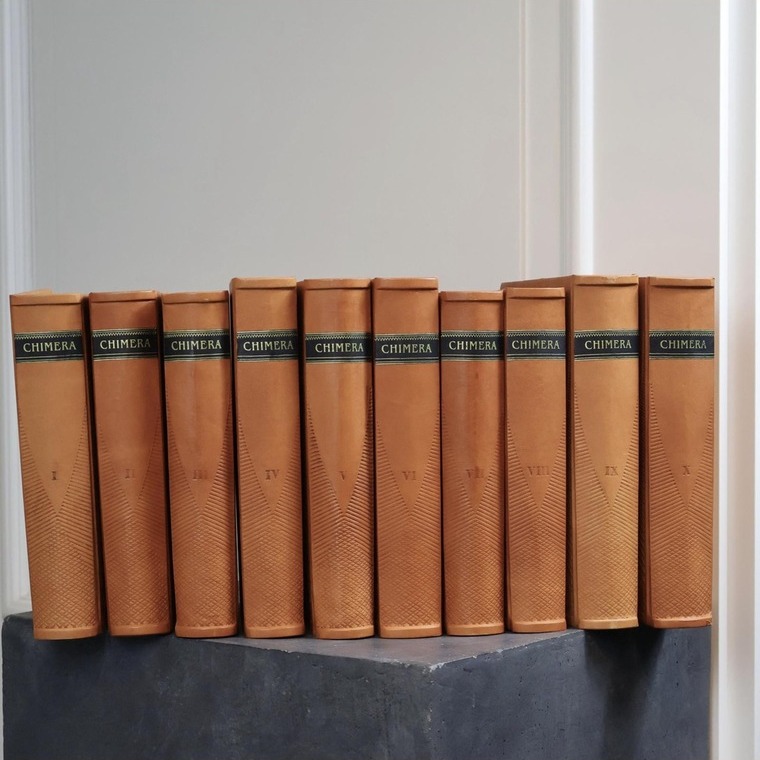
In our view, the gem of the catalogue is a complete run of „Chimera”, the journal Zenon Przesmycki published in Warsaw in 1901–1907. Thirty issues appeared in all, bound in threes into ten volumes, and our set contains every one of them, from the first issue of January 1901. Missing wrappers and some plates are listed in the description. Its contributors included Berent, Leśmian, Kasprowicz, Żeromski, Reymont, Staff, Wyspiański and Miciński; its design was overseen by Edward Okuń, Józef Mehoffer and Franciszek Siedlecki, and the covers of 1904–1907 were designed by Ferdynand Ruszczyc. It was here that Przesmycki published the works of Cyprian Norwid, restoring him to Polish literature. The print run was 600 copies.
Books That Remember Their Owners
Antiquarians love books that remember their former owners, and this catalogue has several. Maryan Czapski’s „Historya powszechna konia” (A General History of the Horse), published in Poznań in 1874, bears on its bindings the gilt armorial stamp of Count Zygmunt Czarnecki of Rusko near Jarocin. His library of about seven thousand works, including 28 incunabula, was bought in 1914 by the Baworowski Foundation Library in Lviv. Czapski’s work itself, here in its first edition, is regarded as one of the most important nineteenth-century Polish books on the horse. The set comprises the three text volumes, without the separately published atlas. Karol Szajnocha’s eight-volume „Dzieła” (Works) of 1876–1877 come from the library of the Counts Bniński at Gułtowy near Poznań: the title pages carry the stamp of Seweryn Bniński with the Łodzia coat of arms.
How to Take Part
We encourage you not to wait until the last minute. Starting prices are only where the bidding begins, and Thursday evening will decide whose library these books go to. Bidding takes place on OneBid. Simply create an account there and click „Zapisz się do aukcji” (Register for the auction). You can leave absentee bids now, and on Thursday 26 November from 7 pm CET bid live from a computer or phone. A 10% buyer’s premium is added to the hammer price. Every lot has a full description in the catalogue, with bibliography and condition, and a series of photographs. If you would like to know more about any of the books, we are happy to answer at info@antykwariatpolski.pl or on +48 608 331 500.
The 22nd Auction catalogue: onebid.pl/en/auction/-/10713. For any questions, please contact us. News of future auctions and new arrivals goes out in our newsletter.

