Cleaning Old Books: What You Can Do Yourself—and What You Should Leave Alone
A copy of *Robinson Crusoe*, published by Gebethner and Wolff, was recently lying on the table in our conservation studio—a book with little market value but great sentimental value to its owner. He decided on a full restoration that would preserve the book’s original substance: no replacement of the cover with a new one, no quick “refreshing,” just a systematic cleaning and reinforcement of what had physically survived. This case clearly illustrates where the line is drawn between what one can safely do on one’s own and what requires the hand of a conservator—and that is precisely the subject of this article.
What You Can Do on Your Own
Safe, at-home care for an old book basically comes down to three steps: dusting, gently cleaning the surface to remove dust and fine dirt, and storing it under the right conditions. A soft brush or a very soft bristle brush is suitable for vacuuming—run it along the spine and the edges of the pages, always moving from the spine outward, so as not to push dirt deeper into the book block. Do not use a vacuum cleaner at full suction power, paper towels, or—as happens surprisingly often—moist wipes soaked in any liquid. If the book simply has a layer of dust and a slightly stained dust jacket, it’s usually safe to clean it yourself.
A leather or canvas cover is a different story
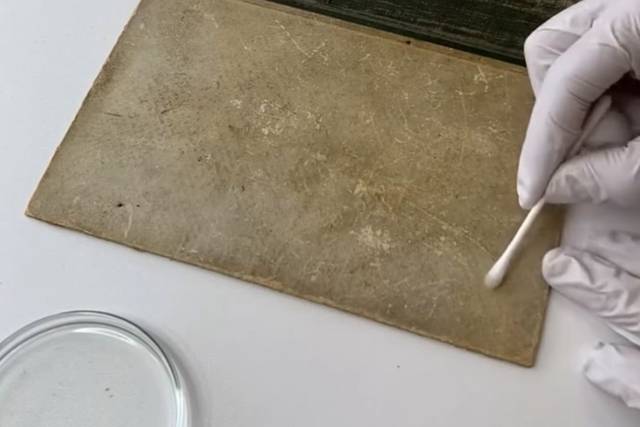
Here, the margin of safety is much narrower than with the pages alone. Bookbinding leather, especially old, dried-out, and cracked leather, reacts unpredictably to water, alcohol, and most household cleaning products—these can dissolve dyes, alter the surface texture, or accelerate cracking. With the cloth-bound copy of *Robinson Crusoe*, we worked precisely under this low-risk protocol: instead of forceful scrubbing, we used spot cleaning with a cotton swab, area by area, while constantly monitoring how the material reacted. This is the difference between cleaning the entire cover in one go and working on a millimeter-by-millimeter scale—slower, but without the risk of irreversibly damaging something. Bookbinding canvas is slightly more forgiving than leather, but the same rule applies here: first, test a small, inconspicuous area, and only then proceed with the rest.
When it’s a matter for the conservator
If a book has mainly sentimental or reading value and is in stable condition—the paper isn’t crumbling, the binding is secure, and there are no visible signs of active mold—simply dusting it off yourself and storing it under good conditions is entirely sufficient. You should have the book professionally preserved without hesitation, especially if there are signs of fungus or mold (characteristic stains, a musty odor), if the paper is so brittle that it tears when turning the pages, if the binding is coming apart from the block, or if the copy has real antiquarian or collector’s value. In the latter case, any unprofessional intervention—even with good intentions—can reduce the book’s value more than the passage of time itself. It’s worth remembering that a copy’s rarity and its market value aren’t always the same, but its condition affects both of these factors simultaneously.
The most common types of damage we see in practice
Water stains or stains from a cloth that was too wet, discoloration from using unsuitable skin care products, smudged print from contact with solvents, and mechanical damage to the spine caused by brushing too aggressively —these are the most common consequences of well-intentioned efforts that went wrong. Historical paper, especially that made from wood pulp at the turn of the 19th and 20th centuries, is much more acidic and brittle than modern paper—what would be a harmless treatment on a new book can accelerate the deterioration of old paper. Therefore, when in doubt, it’s better to do nothing than to do something irreversible.
A loose light fixture is a trap for DIY solutions
Homemade bookbinding adhesives and adhesive tapes are one of the most common sources of problems we encounter with books. Adhesive tape yellows over time, seeps through the paper, and leaves a mark that is very difficult to remove without a trace, while typical office glue does not have the proper pH and eventually damages the paper fibers. If the spine is coming apart or pages are falling out of the block, it’s definitely time to see a conservator—not to use a DIY repair kit. Professional bookbinding repairs use reversible adhesives and materials selected for the specific type of binding, which allows the repair to be reversed if necessary without damaging the original —exactly as in the case of “Robinson,” where the goal was to reinforce the original, not to replace it with something new.
If you have a book at home and aren’t sure about its condition—whether it’s still safe to clean yourself or if it’s a job for a specialist—the easiest thing to do is simply ask before you do anything. Contact us, describe the book’s condition, or send photos, and we’ll advise you whether dusting it at home is sufficient or if it’s better to entrust it to our conservation studio.